Accurate Adrenal Fatigue Testing

Done in the comfort of your home, this comprehensive testing approach evaluates multiple stress-response markers to help identify patterns of dysfunction — when testing is used at the right time and interpreted correctly.

WRITTEN BY

Dr. Andrew Neville
ADRENAL FATIGUE SPECIALIST

SHARE

Article Content

If You Suspect Adrenal Fatigue, Testing Can Feel Like the Obvious Next Step

When symptoms have persisted for months or years, it’s natural to assume that once the right test is ordered, your questions will finally be answered.

For many people, that isn’t what happens. Lab results often come back within normal ranges, even though the body feels anything but normal. Numbers don’t always reflect lived experience, and instead of bringing clarity, test results can raise more questions than they resolve.

Adrenal Fatigue testing can be helpful, but only when it’s used at the right time and interpreted in context. Understanding when testing adds clarity, when it creates confusion, and what matters more than test results is far more important than choosing a specific lab.

When Adrenal Fatigue Testing Helps

Testing is most useful when it supports pattern recognition rather than when it’s expected to deliver a definitive answer on its own.

In Adrenal Fatigue, dysfunction develops gradually as the stress response system remains activated over time. Hormone output, immune signaling, and metabolic regulation shift in patterns rather than appearing as isolated abnormalities.

In this context, testing can help clarify whether cortisol patterns are elevated, suppressed, or unstable, and reveal how other hormones are responding to prolonged stress. It can also support whether symptom patterns align with stress-response physiology and help guide decisions once stabilization has begun.

Testing works best after symptoms are clearly understood and early regulation is underway, not as a first or only step.

Why “Normal” Labs Don’t Rule Out Adrenal Fatigue

One of the most common frustrations people experience is being told their labs look normal despite ongoing symptoms.

This happens because most standard testing:

➟ Captures a snapshot rather than a pattern
➟ Measures hormones bound in tissue rather than what’s biologically active
➟ Misses timing-related dysregulation
➟ Fails to reflect nervous system signaling

Adrenal Fatigue is not a binary condition. Dysfunction often exists long before values fall outside reference ranges. Symptoms frequently appear before lab abnormalities become obvious.

Normal labs do not mean nothing is wrong. They often mean the testing method wasn’t designed to detect stress-response dysfunction.

Blood, Urine, and Saliva Testing: What Each Can and Can’t Show

There are three common ways to evaluate adrenal-related hormones.

Blood testing measures hormone levels present in circulation, most of which are bound to carrier proteins. These values don’t always reflect what tissues are actually experiencing.

Urine testing can provide information about hormone metabolites over time, but interpretation depends heavily on collection accuracy and context.

Saliva testing measures free-fraction hormones, the portion available to tissues. When collected at multiple points throughout the day, it can help reveal circadian rhythm patterns that single blood draws miss.

Each method has limitations. None should be interpreted in isolation.

What Comprehensive Testing Attempts to Capture

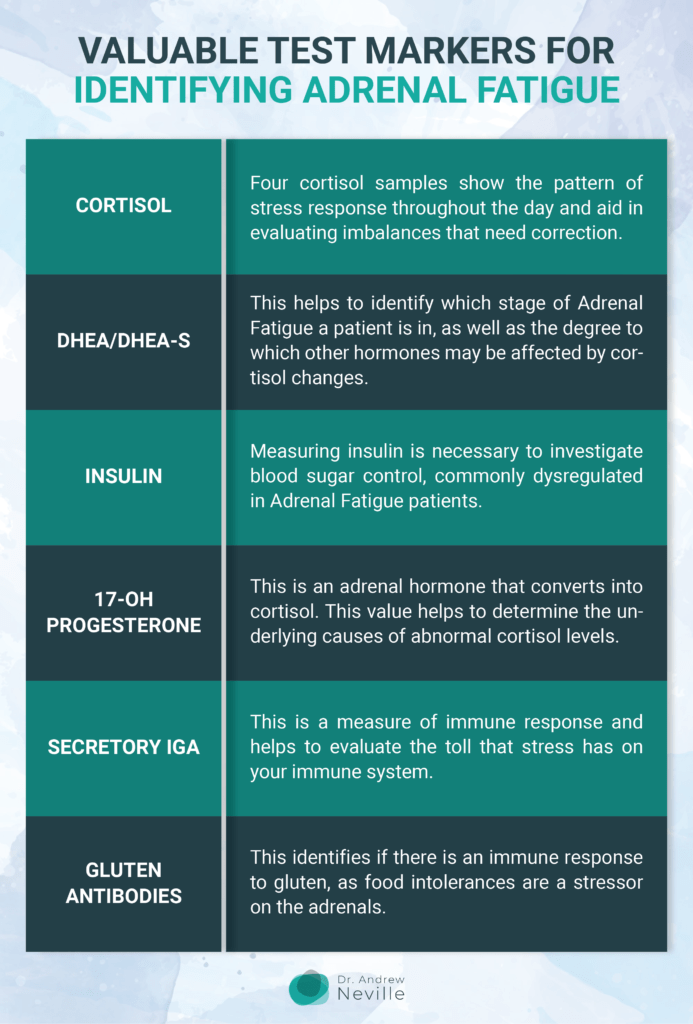
Some testing approaches aim to evaluate multiple stress-response markers together in order to reveal broader patterns rather than isolated values.

These markers may include:

Cortisol
Multiple samples throughout the day help show how the stress response behaves from morning through night.

DHEA / DHEA-S
These values help assess how long the body has been compensating for stress and whether hormone reserves are becoming depleted.

Insulin
Blood sugar regulation is commonly affected by stress physiology and can contribute to fatigue, anxiety, and crashes.

Secretory IgA
This reflects immune system stress and mucosal immune function, which are often impacted during prolonged stress states.

17-OH Progesterone
This helps evaluate upstream hormone signaling that influences cortisol production.

Gluten antibodies
Food-related immune responses can act as additional stressors on an already taxed system.

This type of testing attempts to show how systems are interacting, not simply whether a single hormone is low or high.

This information is only useful when interpreted alongside symptoms, nervous system state, and clinical history.

Testing Is a Tool, Not the Answer

Adrenal Fatigue cannot be assessed by a lab value alone.

Testing does not reveal how sensitive the nervous system has become, how much functional capacity remains, how close the body is to a crash, or how quickly regulation can be restored. Those aspects of healing are reflected in symptom patterns, stress tolerance, and how the body responds over time.

When testing is used thoughtfully, it can support decision-making. When it’s relied on too early or too heavily, it often adds confusion rather than clarity.

Do You Actually Need Testing Right Now?

Not everyone benefits from testing at the same point in the healing process.

In some cases, symptoms provide clearer guidance than labs.

In others, testing helps confirm patterns and guide decisions, but only when results are interpreted in context.

Understanding whether testing will clarify your situation or add noise matters more than ordering the next panel.

Learn How Dr. Neville Decides When Testing Is Helpful

FAQs: Adrenal Fatigue Testing

Why do my labs look normal if I feel awful?

Adrenal Fatigue develops as a stress-response dysfunction over time. Symptoms often appear before hormone levels fall outside standard reference ranges. Many common tests are designed to detect disease states, not early or evolving stress-response patterns.

Is saliva testing better than blood testing for Adrenal Fatigue?

Saliva testing can reveal daily cortisol patterns that blood tests often miss because it measures free-fraction hormones available to tissues. However, no testing method is definitive on its own. Interpretation matters more than the type of test used.

Should I test for Adrenal Fatigue before starting treatment?

Often, no. Early treatment decisions are frequently guided by symptom patterns and nervous system regulation rather than lab results. Testing is most helpful once symptoms are understood and stabilization has begun.

Can Adrenal Fatigue testing tell me what stage I’m in?

Testing can support staging by revealing hormone patterns, but stages are best understood through symptom progression and functional capacity over time. Lab values alone do not define a stage.

How often should Adrenal Fatigue testing be repeated?

Testing should only be repeated when results will meaningfully change clinical decisions. Routine or frequent retesting without a clear purpose often adds confusion rather than clarity.

Learn How Dr. Neville Decides When Testing Is Helpful

WRITTEN BY

Dr. Andrew Neville
ADRENAL FATIGUE SPECIALIST

SHARE

Looking for clarity on what Adrenal Fatigue really is?

Dr. Neville’s FREE minicourse offers a clear breakdown
of what your body is going through.

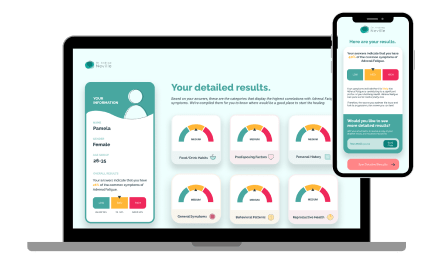
Not sure if you have Adrenal Fatigue?

Dr. Neville’s assessment tool will provide you with clarity on
the severity of your symptoms and how to treat them.

Dr. Neville’s assessment tool will provide you with clarity on the severity of your symptoms and how to treat them.

Popular Articles

Adrenal Fatigue Resources

Adrenal Fatigue Resources

Get healing help for fatigue, pain, insomnia, brain fog and more…right to your inbox.

web tasarım kocaeli web tasarım istanbul web tasarım ankara web tasarım izmit web tasarım gebze web tasarım izmir web tasarım kıbrıs profesyonel logo tasarımı