

Why Adrenal Fatigue in Women Is So Prevalent
Untreated chronic health issues can leave you feeling exhausted, frustrated, and like someone you no longer recognize. Unfortunately, it’s all too common for patients, especially women, to be misunderstood and mistreated by doctors. This can go on for years before women find any real help for the symptoms of Adrenal Fatigue.
Research has shown that women’s health concerns are dismissed by doctors regularly. In fact, so many studies like this one show that women with pain can be perceived by doctors and nurses as “hysterical, emotional, complaining, not wanting to get better, malingerers, and fabricating the pain,” as if it is all in her head.
Other studies showed that women with chronic pain are assigned psychological rather than physical causes for their pain.
Naturally, if you have chronic illness, this can lead to years of searching for proper treatment and getting no answers. You end up watching your time waste away, your symptoms get worse, and your relationships suffer.
How So Many Chronic Symptoms Are Linked to Adrenal Fatigue
Adrenal Fatigue is not a diagnosis or disease. It is a dysfunction of the entire stress response system, and each person affected by it has a very similar “symptom picture.” Unfortunately, each of the symptoms is often mistakenly attributed to another illness or condition.
One of the major obstacles in finding the right care team is doctors tend to treat only symptomatically. They do not often look at the person and her symptoms holistically. When doctors are busy focusing on one symptom at a time, no true, lasting healing progress is made.
For instance, if you have anxiety, you’ll receive a script for an anti-anxiety med. And if you also have IBS, they’ll send you home with a pharmaceutical or OTC GI treatment. But they’re not considering that there may be the same root cause for both!
Adrenal Fatigue is a common cluster of symptoms and needs to be treated as such. Yes, you may have anxiety, IBS, insomnia, and a thyroid disorder. And yes, they can all have one root cause.
I have seen thousands of patients over the past 20+ years. I have dug my heels into researching every aspect of the stress response, chronic fatigue, and the myriad symptoms associated with this condition.
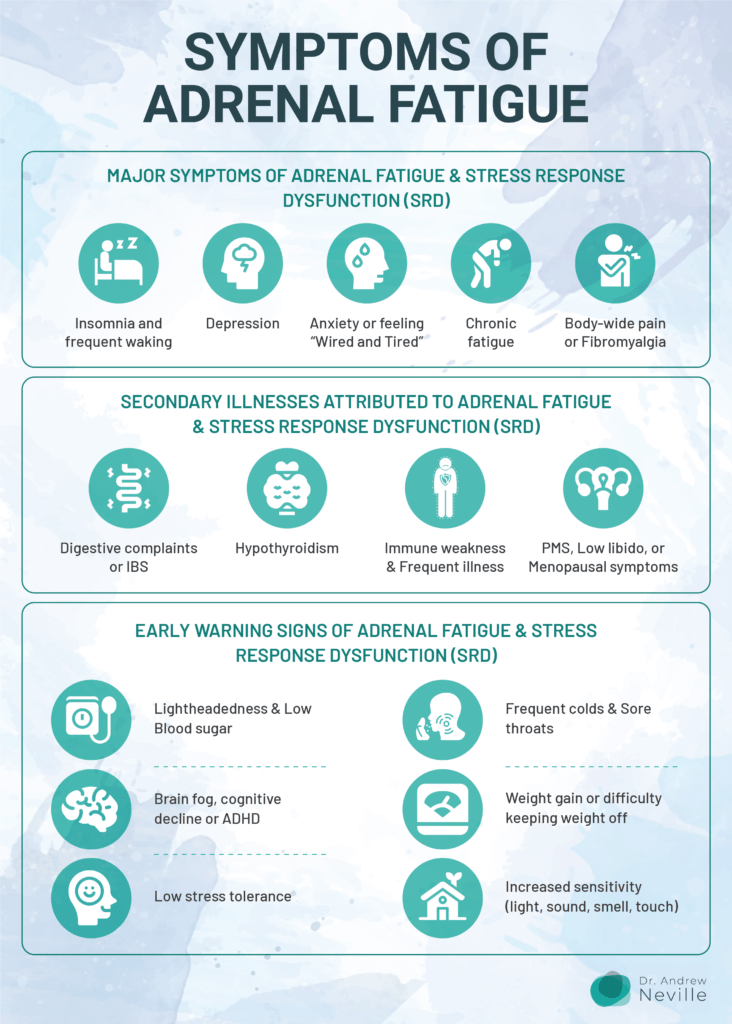
While I know that no two Adrenal Fatigue patients are exactly the same, all of them share 4 or more of these 7 major symptoms.
#1 Anxiety (“Wired” But Tired)
A large portion of my patients are not only tired, but they are “wired” as well. This type of anxiety is a top symptom of Adrenal Fatigue. When we talk about feeling “wired,” I mean feeling hypervigilant, adrenalized, stuck in fight-or-flight, or overwhelmed because the anxiety can make everything feel that much harder to do.
This “wired” state is very common if you have a stress response dysfunction, aka Adrenal Fatigue. It is also the most unpleasant, debilitating state associated with this condition, causing anxiety, shakes and tremors, racing and ruminating thoughts, worry, and fear.
Being wired or anxious is not only psychological; a big part of it is physical, biochemical, and neurological.
This wired feeling is a sign that your stress response is active, most likely overactive. Being wired is keeping you hypervigilant and even more prone to stress. It means your body is pumping out stress hormones, like cortisol and adrenaline.
It is these hormones that spread throughout the body and cause all the damage associated with Adrenal Fatigue, especially this wired but tired feeling.
#2 Insomnia and Frequent Waking
You hit the pillow each night and simply cannot get your brain to slow down and let you fall asleep. Or perhaps falling asleep is okay, but you routinely wake up every night only a few hours later to lie in bed wide awake, exhausted and frustrated. These nights turn into weeks, months, and maybe even years of restless, interrupted sleep.
Chronic stress disrupts healthy sleep patterns and keeps the body out of ‘heal and repair’ mode.
Sleep is essential to well-being, healing, and repair. The mechanisms that control our sleep are complex. All of these intricate events that must occur in order to get that shut-eye are disrupted by chronic stress.
Especially in combination with other symptoms of Adrenal Fatigue, these sleep disturbances can become completely consuming and anxiety-provoking. Lack of quality sleep prevents you from living your normal life.
The paradox of this condition is that sleep disorders occur because of Adrenal Fatigue, and Adrenal Fatigue is worsened by sleep disorders. Without the necessary healing and repair that occurs while we sleep, it is hard to break this harmful cycle … but it is possible!
Your body is telling you that Adrenal Fatigue has taken over.
#3 Chronic Fatigue (the Hallmark Symptom of Adrenal Fatigue)
When you’re more than “just tired,” it affects every area of your life.
Your family misses you. Perhaps your spouse doesn’t understand where their partner went. Your career suffers. And your home is more difficult to keep neat or clean. Sometimes even taking care of yourself seems impossible.
Fatigue in Adrenal Fatigue patients is more than “just tired.”
Perhaps you’ve gotten some “helpful” advice: just get some exercise, eat some red meat, or go to a therapist.
These unfortunate, ignorant comments come from people—often well-meaning—who simply don’t get it. It is not a choice. You cannot physically or mentally push yourself any further.
For most of us, fatigue is a difficult condition to quantify and describe. We’ve all been “tired” before; but we rest, catch up on sleep, take better care of ourselves, and rebound.
When you have Adrenal Fatigue, that is not the case. There is no rebound. Your body has been pushed too hard for too long, and it’s telling you that it cannot function this way any more.
#4 Bodywide Pain or Fibromyalgia
If you’ve gone to your doctor with complaints of body-wide pain, they probably tried to rule out several well-known causes. They’ve crossed conditions such as arthritis, osteoarthritis, rheumatoid arthritis, and muscle strain off the diagnosis list.
If those causes are ruled out, the doctor then may telll you it’s just the aches and pains of getting older. They tell you you’ll need to take some NSAIDs when it’s bad. They may have even given you a diagnosis of Fibromyalgia, especially if you are also fatigued.
Fibromyalgia is medical jargon for chronic transient pain of unknown cause with no known effective treatment.
I assure you, there is a cause for the body-wde aches and pains you’re always experiencing.
Adrenal Fatigue causes inflammation. Inflammation causes pain. Chronic inflammation also acts as an additional biochemical stress, which perpetuates the entire body’s dysfunction and causes it to over-perceive its environment. This is called “Central Sensitization.”
Central Sensitization is the phenomenon of an upregulated nervous system and a trigger-happy limbic system. It causes the body to be on high alert, all the time. This is easiest to observe in the sensory nerves.
This over-perception creates hypersensitivity to touch and physical sensations: fibromyalgia or body-wide, transient, chronic pain. Once the Adrenal Fatigue and Stress Response Dysfunction are healed, the chronic pain dissipates.
#5 Immune Weakness or Recurring Viruses (EBV, Long COVID, Lyme)
Most of us know inherently that stress weakens the immune system. We go through a stressful time, and we get sick or get a cold sore. The reason for this is that while stress hormones will help our physiology rise to the occasion to meet whatever stressful situation that comes along, it does so at a cost.
Excess stress hormones cortisol and adrenaline cause a predictable immunological shift in the body. This shift weakens one side of the immune system while leaving another side overactive.

The weakened side of the immune system is the side that fights infection. This is why many patients who suffer from Adrenal Fatigue will catch every cold or virus that comes along. They also hcan ave trouble with viruses that can reactivate, like Long Covid, chronic Lyme, and Epstein Barr.
The side of the immune system that becomes overactivated is the part that creates antibodies. When this occurs, patients will develop allergic reactions to their environment and food.
The key to being free of chronic infections, allergies, and even autoimmune diseases is to support and balance the immune system, of course. But it is most effective and longer-lasting to treat Adrenal Fatigue, the underlying cause. Doing so gets the immune system back into balance on its own.
#6 Depression
My patients with Adrenal Fatigue are commonly dismissed as having depression. This myth stems from most well-meaning physicians finding no biological abnormality (though they exist) for the various symptoms with which my patients present. The next logical—though inaccurate—step for these physicians is to assume and often tell the patient “it’s all in your head” and write a prescription for an antidepressant.
The excess cortisol produced by the stress response dysfunction eventually gets into the brain and can affect your neurotransmitters, like serotonin, dopamine, or gaba. It puts a major strain on those neurotransmitters, and causes the symptoms of depression. The depression is secondary to the Adrenal Fatigue.
I constantly have to reassure my Adrenal Fatigue patients: ‘It’s not all in your head.’
This is not to say that my patients do not suffer periodically from depression. Honestly, I’d start worrying about their mental health if they didn’t. One way to tell if it’s clinical depression or secondary depression? Ask yourself, “What would I be doing if I felt better?” Most often, clinically depressed patients have no answer and no interest. On the other hand, if depression is secondary to other factors, the answer is usually a long list of things that you used to love about life.
#7 Digestive Disorders (IBS and Leaky Gut)
Many of us already know stress leads to GI upset. But not everyone thinks about the physiological correlation between the stress response and the digestive process. Chronic stress is detrimental to the entire gastrointestinal process. It leads to more than just a little indigestion on a bad day.

Digestion, when functioning properly, is a well-orchestrated process involving the nervous system, digestive enzymes, and stomach acid. But if we’re in a constant stress response, as we are if we have Adrenal Fatigue, the limbic system of the brain is telling the digestive system to shut down. All the body’s resources and energy are needed to fight whatever the stress may be. (After all, if you’re under attack, sitting down for a meal or having a bowel movement aren’t ideal activities.)
If you have chronic stress coming from everywhere all the time, your body begins to think there are threats lurking around every corner. If it perceives everything as a threat, then, by design, it will continually suppress your digestive function so you are able to deal with all those hazards.
This chronically suppressed digestion is what leads to IBS, leaky gut, acid reflux, diarrhea, constipation, and dysbiosis.
Don’t Wait to Heal the Symptoms of Adrenal Fatigue
As these symptoms occur and worsen, the chronic exhaustion associated with Adrenal Fatigue increases.
Even basic tasks—climbing stairs, folding laundry, a trip to the store—can leave you spent for the rest of the day. You drive yourself with caffeine (or sugar), but you experience only a brief lift in energy before the inevitable crash.
A “detox” or artificial hormones alone won’t fix things either. These are all just well-marketed, one-size-fits-all products aimed at temporarily alleviating symptoms. None of these will address the root cause of your exhaustion, depression, insomnia, or immune weakness.
The symptoms of Adrenal Fatigue can have a catastrophic impact on your quality of life. They also often go ignored or mistreated by doctors for years. Why? In medical school, the conglomeration of these symptoms is not considered a condition in and of itself.
Healing the Root of These Symptoms Starts Here
Fixing the entire stress response system, not just the dysfunctional adrenals, heals the root cause of these symptoms. We must balance the hormones of the HPA Axis, heal the autonomic nervous system (ANS), and calm the limbic system of the brain. I do this using My “Trilateral” Approach to Healing Adrenal Fatigue.